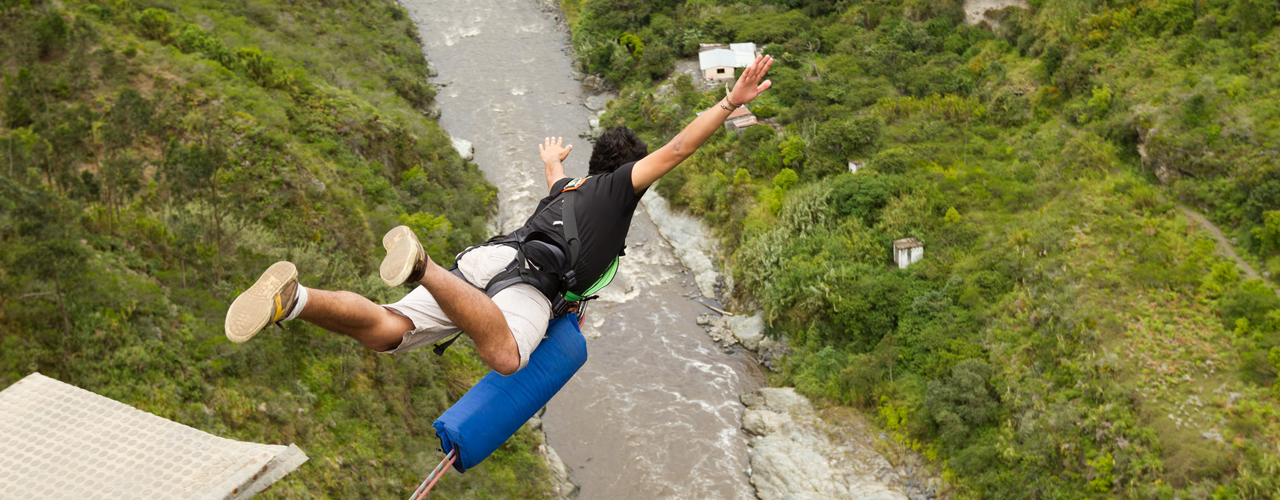
Bungee jumping
Bunjee jumping is more than just a leap of faith. It is a free fall that eliminates fear from the heart and instills courage to overcome the biggest of obstacles. And there is no better place to discover a new you than in the lap of nature surrounded by rolling hills. Rishikesh in Uttarakhand is home to one of the highest bunjee platforms in the country – 83 m (about 272 ft).
Bungee jumping, also spelled bungy jumping, is an activity that involves a person jumping from a great height while connected to a large elastic cord. The launching pad is usually erected on a tall structure such as a building or crane, a bridge across a deep ravine, or on a natural geographic feature such as a cliff. It is also possible to jump from a type of aircraft that has the ability to hover above the ground, such as a hot-air-balloon or helicopter. The thrill comes from the free-falling and the rebound. When the person jumps, the cord stretches and the jumper flies upwards again as the cord recoils, and continues to oscillate up and down until all the kinetic energy is dissipated.
Equipment
| This section does not cite any sources. Please help improve this section by adding citations to reliable sources. Unsourced material may be challenged and removed. (November 2015) (Learn how and when to remove this template message) |

Bungee Jump in Normandy, France (Souleuvre Viaduct)
A steel cage platform used for lifting it with a mobile crane. In the center of the base, a 15 cm wide hole with rounded plastic rim is provided to guide the bungee rope during the jump.
The elastic rope first used in bungee jumping, and still used by many commercial operators, is factory-produced braided shock cord. This special bungee cord consists of many latex strands enclosed in a tough outer cover. The outer cover may be applied when the latex is pre-stressed, so that the cord’s resistance to extension is already significant at the cord’s natural length. This gives a harder, sharper bounce. The braided cover also provides significant durability benefits. Other operators, including A. J. Hackett and most southern-hemisphere operators, use unbraided cords with exposed latex strands. These give a softer, longer bounce and can be home-produced.
Accidents where participants became detached led many commercial operators to use a body harness, if only as a backup for an ankle attachment. Body harnesses generally derive from climbing equipment rather than parachute equipment.
The highest jump
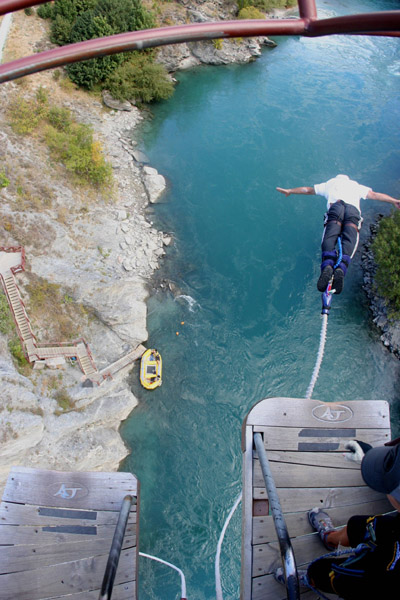
Looking down from atop the Verzasca Dam bungee tower near Locarno in Ticino, Switzerland
In August 2005, AJ Hackett added a SkyJump to the Macau Tower, making it the world’s highest jump at 233 metres (764 ft). The SkyJump did not qualify as the world’s highest bungee as it is not strictly speaking a bungee jump, but instead what is referred to as a ‘Decelerator-Descent’ jump, using a steel cable and decelerator system, rather than an elastic rope. On 17 December 2006, the Macau Tower started operating a proper bungee jump, which became the “Highest Commercial Bungee Jump in the World” according to the Guinness Book of Records. The Macau Tower Bungy has a “Guide cable” system that limits swing (the jump is very close to the structure of the tower itself) but does not have any effect on the speed of descent, so this still qualifies the jump for the World Record.
Kushma Bungee Jump is the world’s second-highest bungee jump with a height of 228 metres (748 ft).[22] It is located in the George of Kaligandaki River and world-first natural canon bungee jump. Another commercial bungee jump currently in operation is just 13 metres (43 ft) smaller, at 220 metres (720 ft). This jump, made without guide ropes, is from the top of the Verzasca Dam near Locarno, Switzerland. It appears in the opening scene of the James Bond film GoldenEye. The Bloukrans Bridge Bungy in South Africa and the Verzasca Dam jumps are pure freefall swinging bungee from a single cord.
Guinness only records jumps from fixed objects to guarantee the accuracy of the measurement. John Kockleman however recorded a 670-metre (2,200 ft) bungee jump from a hot air balloon in California in 1989. In 1991 Andrew Salisbury jumped from 2,700 metres (9,000 ft) from a helicopter over Cancun for a television program and with Reebok sponsorship. The full stretch was recorded at 962 metres (3,157 ft). He landed safely under parachute.
One commercial jump higher than all others is at the Royal Gorge Bridge in Colorado. The height of the platform is 321 metres (1,053 ft). However, this jump is rarely available, as part of the Royal Gorge Go Fast Games—first in 2005, then again in 2007. Previous to this the record was held in West Virginia, USA, by New Zealander Chris Allum, who bungee jumped 251 metres (823 ft) from the New River Gorge Bridge on “Bridge Day” 1992 to set a world’s record for the longest bungee jump from a fixed structure.
Risk of injury
Jumping at Kawarau Gorge Suspension Bridge in Queenstown, New Zealand, April 2007
Bungee jumping injuries may be divided into those that occur after jumping secondary to equipment mishap or tragic accident, and those that occur regardless of safety measures.
In the first instance, injury can happen if the safety harness fails, the cord length is miscalculated, or the cord is not properly connected to the jump platform. In 1986, a man died during rehearsals for a bungee jumping stunt on a BBC television programme, because the cord sprang loose from a carabiner clip.
Injuries that occur despite safety measures generally relate to the abrupt rise in upper body intravascular pressure during bungee cord recoil. Eyesight damage is the most frequently reported complication Impaired eyesight secondary to retinal haemorrhage may be transient or take several weeks to resolve. In one case, a 26-year-old woman’s eyesight was still impaired after 7 months. Whiplash injuries may occur as the jumper is jolted on the bungee cord and in at least one case, this has led to quadriplegia secondary to a broken neck. Very serious injury can also occur if the jumper’s neck or body gets entangled in the cord. More recently, carotid artery dissection leading to a type of stroke after bungee jumping has also been described.