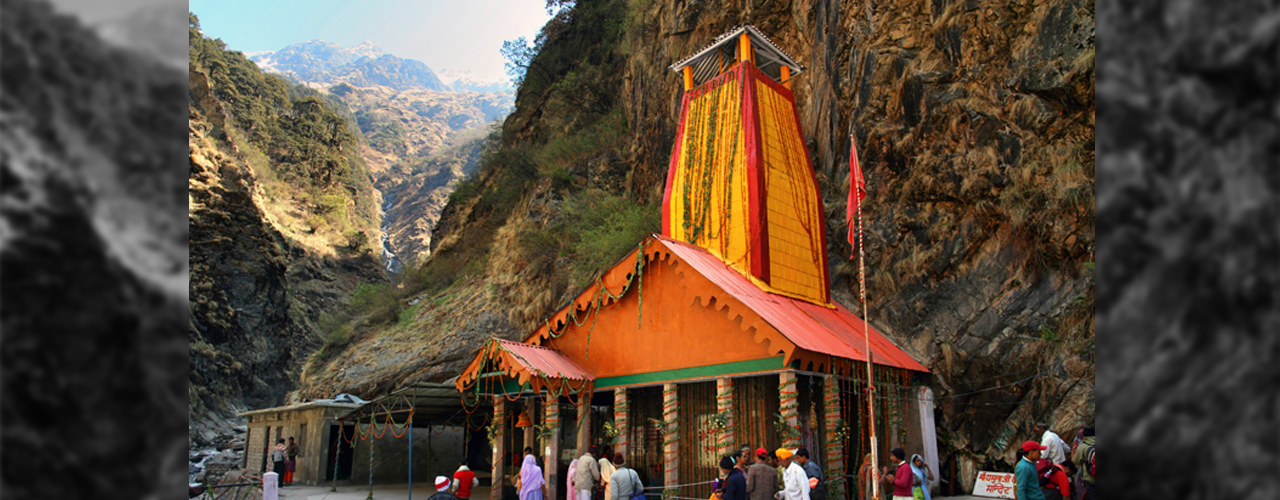
Yamunotri
Yamunotri is a part of Char Dham (along with Gangotri, Kedarnath and Badrinath), the four most revered Hindu pilgrimages in the Himalayas. The small mountain hamlet, with the Yamunotri Temple at its centre, attracts thousands of devotees every year and is the commencing point of the Char Dham Yatra pilgrimage (May to October), which proceeds from Yamunotri to Gangotri and finally to Kedarnath and Badrinath. Lodged in a narrow gorge, close to the source of the Yamuna, the Yamunotri Temple is dedicated to Yamuna, the second-most sacred river after the Ganges. A dip in River Yamuna is said to protect one from untimely death. Devotees either walk or ride a palanquin or a pony to reach the temple (around 3,233 m above sea level) from Janki Chatti, a steep trek of about 3 km that takes about 3 hours.
Best Time To Visit: April to June and September to November.
Yamunotri, also Jamnotri, is the source of the Yamuna River and the seat of the Goddess Yamuna in Hinduism. It is situated at an altitude of 3,293 metres (10,804 ft) in the Garhwal Himalayas and located approximately 150 kilometers (93 mi) North of Uttarkashi, the headquarters of the Uttarkashi district in the Garhwal Division of Uttarakhand, India. It is one of the four sites in India‘s Chhota Char Dham pilgrimage. The sacred shrine of Yamunotri, source of the river Yamuna, is the westernmost shrine in the Garhwal Himalayas, perched atop a flank of Bandar Poonch Parvat. The chief attraction at Yamunotri is the temple devoted to the Goddess Yamuna and the holy thermal springs at Janki Chatti which is 7 km away.
The actual source, a frozen lake of ice and glacier (Champasar Glacier) located on the Kalind Mountain at a height of 4,421 m above sea level, about 1 km further up, is not frequented generally as it is not accessible; hence the shrine has been located on the foot of the hill. The approach is extremely difficult and pilgrims therefore offer puja at the temple itself.

Yamunotri temple was built by Maharani Guleria of Jaipur in the 19th century.
The temple of Yamuna, on the left bank of the Yamuna, was constructed by Maharaja Pratap Shah of Tehri Garhwal. The deity is made of black marble. The Yamuna, like the Ganges, has been elevated to the status of a divine mother for the Hindus and has been held responsible for nurturing and developing the Indian civilization.
There are hot water springs located close to the temple. Surya Kund is the most important kund. Near the Surya Kund there is a shila called Divya Shila, which is worshipped before puja is offered to the deity. Devotees prepare rice and potatoes, tied in muslin cloth, to offer at the shrine by dipping them in these hot water springs. The cooked rice is taken back home as prasadam. The pujaris of Yamunotri come from the village of Kharsali near Janki Chatti. They are the administrators of the sacred place and perform religious rites. They are well-versed in the Shastras.